
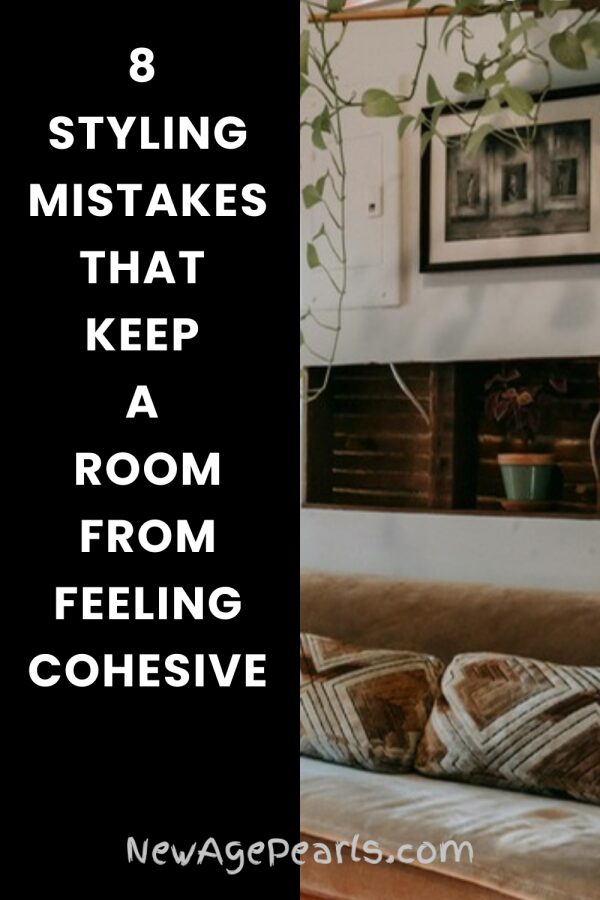
A room can contain all the right individual pieces yet still feel disjointed and incomplete. This frustrating disconnect happens when styling mistakes undermine cohesion. The space works on paper but fails in reality because subtle inconsistencies create visual chaos. Understanding these eight mistakes helps you diagnose why rooms feel off and make targeted corrections that bring everything together.
Too Many Competing Focal Points
Rooms need one clear star—a fireplace, large piece of art, beautiful window—that everything else supports. When multiple elements compete for attention equally, your eye doesn’t know where to focus. The visual confusion reads as chaos rather than cohesion. A bright accent wall competes with a gallery wall which competes with a statement light fixture—none wins, and the room loses. Fix this by choosing one dominant element and making others secondary. Paint the accent wall neutral so the gallery wall shines, or remove the gallery wall to let the architectural feature dominate. One focal point creates order; multiple create disorder. Supporting elements should enhance the focal point without competing with it.
Mismatched Undertones
This subtle mistake undermines cohesion more than obvious color clashes. Cool grays mixed with warm beiges, blue-toned woods with orange-toned woods, cool whites with cream—these undertone mismatches create dissonance your brain registers as wrong even if you can’t articulate why. Everything might technically be “neutral,” but the room still feels off because undertones clash. Audit your space for undertone consistency. Choose either warm or cool as your direction and ensure everything leans that way. Warm spaces need warm woods, warm grays, cream rather than stark white. Cool spaces need cool grays, blue or gray-toned woods, pure white. This consistency creates harmony that mismatched undertones destroy.
Too Many or Too Few Patterns
Cohesive rooms balance patterns carefully. Too many competing patterns create visual noise; too few make spaces flat. The solution is varying pattern scales and limiting types. Use one large-scale pattern, one medium-scale, and one small-scale. Ensure patterns share at least one color that connects them. If you have a busy geometric rug, pair it with simpler pillows rather than competing patterns. Or use all solid colors with varied textures instead of patterns. Either approach works; mixing them randomly doesn’t. The key is intentional distribution and scale variation. Patterns should relate through shared colors or styles while differing in scale.
Inconsistent Style Signals
Rooms feel cohesive when pieces share design language even if they’re not matching sets. Mixing ultra-modern with shabby chic with industrial with coastal sends conflicting signals. This doesn’t mean everything must be identical—it means pieces should share enough common ground to feel related. Choose a primary style direction—maybe modern with organic elements—and ensure most pieces align. Include a few contrasting items for interest, but not so many that your style direction becomes unclear. When rooms lack clear stylistic point of view, they feel scattered. Cohesion comes from pieces that relate, creating conversation rather than chaos.
Wrong Scale Relationships
Pieces can be individually appropriate sizes yet wrongly scaled relative to each other. A delicate coffee table under a massive sofa looks lost. Oversized lamps on tiny side tables appear unstable. Scale relationships matter as much as absolute sizes. Furniture should relate proportionally—substantial sofas need substantial coffee tables, delicate chairs need appropriately scaled side tables. When pieces are wrongly scaled relative to each other, they feel disconnected even if they share colors and style. Assess whether your pieces feel harmonious in size relationships. Mismatched scale is common but easily fixed by swapping pieces to create better proportion relationships.
No Repeated Colors or Materials
Cohesion requires repetition. If you have brass in one corner and nowhere else, it feels random. If blue appears on one pillow and nowhere else, it looks mistaken. Successful rooms repeat key colors and materials multiple times throughout. This creates visual threads that tie disparate elements together. If your rug has rust tones, echo rust in pillows, art, or accessories. If you have wood furniture, include wooden accessories or frames. The repetition doesn’t need to be heavy-handed—just enough that your eye recognizes the pattern. These repeated elements create the cohesion that makes rooms feel intentional and complete.
Poor Lighting Distribution
Cohesive rooms have balanced lighting that illuminates spaces evenly. When some areas are bright and others dark, or when all light comes from one source, spaces feel disjointed. Different zones appear disconnected rather than unified. Add multiple light sources distributed throughout—table lamps, floor lamps, accent lighting. Ensure all bulbs match in color temperature. This lighting consistency makes rooms feel like single unified spaces rather than collections of separate areas. Light distribution significantly affects cohesion yet is often overlooked in favor of more obvious style elements.
Missing Transitional Elements
Rooms feel disjointed when contrasting elements touch directly without transition. A heavy dark piece next to a light delicate piece needs something between them that relates to both. Transitional pieces bridge gaps and create flow. This might be a medium-weight item in a middle tone, or an object that combines characteristics of both neighboring pieces. These transitions prevent jarring jumps that break cohesion. Think of them as visual diplomats that help different elements coexist peacefully. Without transitions, contrasts feel harsh; with them, variety feels intentional.
Fixing these mistakes often requires minimal intervention. Sometimes just removing one competing focal point solves everything. Other times, swapping to undertone-consistent neutrals creates instant cohesion. The key is diagnosing which specific mistake affects your room most severely and addressing it directly.
Start by identifying your room’s biggest cohesion problem. Do you have three focal points competing? Eliminate two. Are undertones mismatched? Replace the worst offenders. Too many patterns? Remove several or vary their scales. Unclear style direction? Identify your dominant style and edit pieces that don’t align. Wrong scale relationships? Swap pieces to create better proportions. No repeated elements? Add touches of existing colors and materials throughout. Poor lighting? Add sources and match bulb temperatures. Missing transitions? Add medium pieces between contrasting elements.
These corrections often feel dramatic—removing beloved but competing elements, swapping working furniture for better-scaled options—but the results justify the effort. A cohesive room feels exponentially better than a collection of nice items that don’t work together. Cohesion creates peace and completeness that individual pieces, however beautiful, cannot achieve alone.
Leave a Reply